

Adventurism Time!
Some differing opinions on the political value of cool crimes

Perhaps you are aware of a recent furor in the national press about a man named Hasan Piker, a (it must be said, very handsome) Twitch streamer and socialist firebrand who has been gaining popularity over the last decade.
Hopefully you are not, as it’s all very silly. I am not going to talk about Piker or the feverish slate of articles that have emerged in response to his growing national profile, but if you want to know more, this podcast is a pretty accurate and entertaining summary.
What I do want to talk about, however, is the response to one particular comment that Piker made, because it is very interesting and funny to me that it has become a subject of discussion at the national level. In an interview with Ross Douthat, Piker says of the assassination of United Healthcare CEO Brian Thompson, “I think it’s one of the most consequential instances of adventurism, which I always will say is wrong”, which has led to a spate of pearl-clutching misinterpretations about the idea of ‘adventurism’ itself. This is, like I said, very funny, because frankly this is deep Marxist nerd shit and the American press is 0% qualified to discuss it. So let’s do it here!
Propaganda of the Deed
In the 19th century, as socialism and socialist-adjacent political ideologies were beginning to take form and gain serious power, there was a lot of discussion over strategy, tactics, focus, etc. A lot. Too much, to be frank, but in fairness it was very difficult, even with the help of the immortal science of dialectical materialism, to know how to achieve success in the face of the entrenched capitalist and bourgeois powers of the time.
One particularly sticky point of disagreement was over the value of individual acts of violence or terror. Early thinkers in the anarchist tradition called this “propaganda of the deed”, though even within their camp there was disagreement over what the meant and how far one ought to go. It likely started with Italian anarchists in Naples in the 1850s, but the idea soon took root in France, Russia, and elsewhere. One proponent, Carlo Cafiero, wrote in a paper in 1880 that “Our action has to be permanent revolt by the spoken and written word, the sword, dynamite or even sometimes the voting paper […]. We are consistent: we use a weapon the moment we have to strike as rebels. Everything is good for us which is not legality”. Advocates of the idea thought that political change could be hastened or even created by bombings, assassinations, arson, and other dramatic acts of violence or disruption. One could very accurately call this terrorism, and many of the anarchists of the era would enthusiastically agree with that.
There was something powerful in the idea of this kind of opposition, and the restrictive nature of autocratic governments at this time led to some extreme positions on the validity of the use of force. Related concepts like “illegalism” emerged, a wholesale opposition to the legal order and an enthusiastic endorsement of Robin Hood-style theft and attacks on property. After major setbacks like the failure of the Paris Commune, anarchists and socialists in search of an effective lever carried out assassinations, robberies, bombings, and arsons all over Europe, some with principled and focused intent, others less so.
The late 19th century was rife with these types of actions. The Russian revolutionary group Narodnaya Volya (“People’s Will”) operated deliberately on the idea of direct action and after multiple attempts successfully assassinated Tsar Alexander II in 1881 with a bomb.
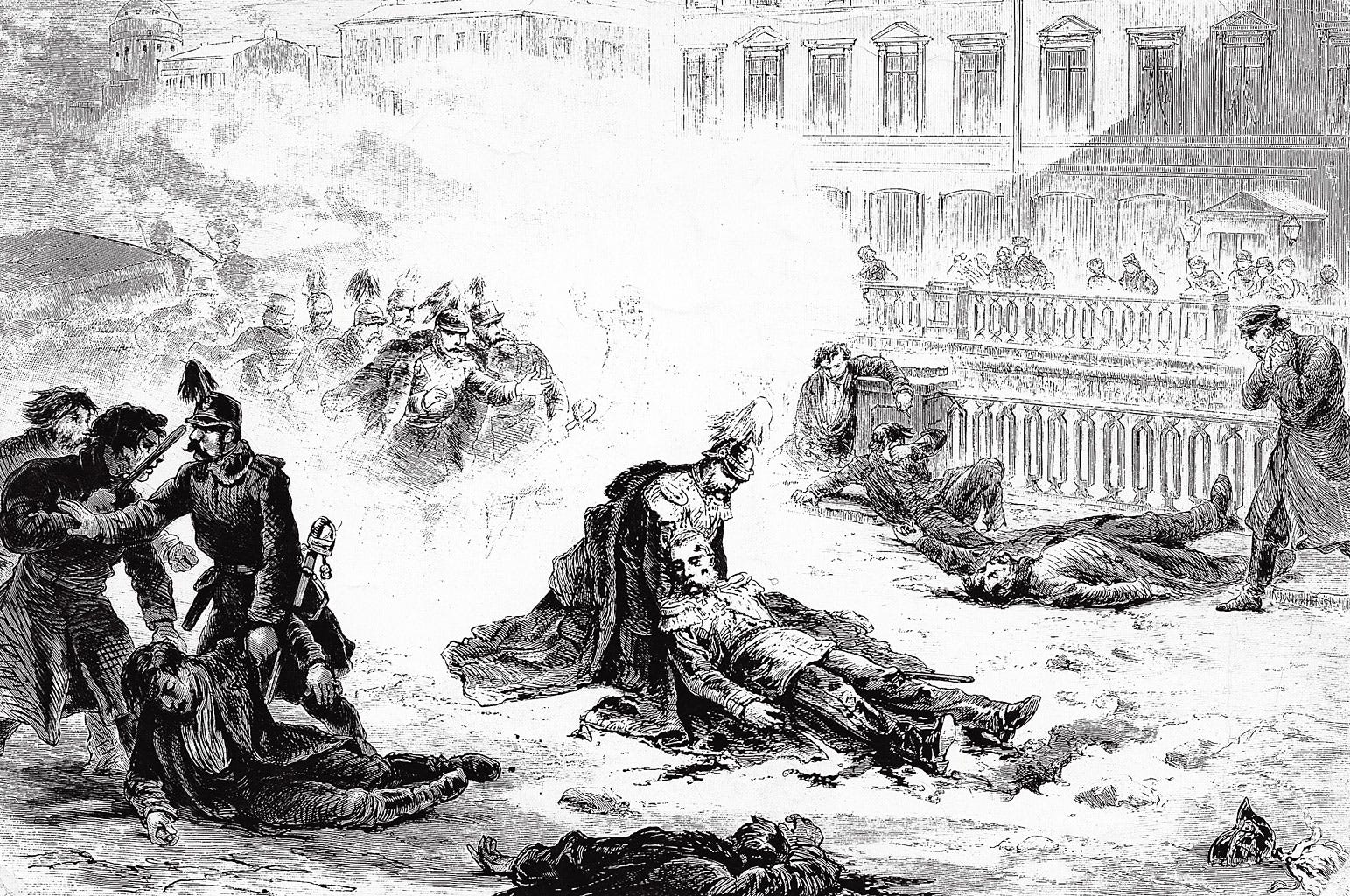
This success emboldened others. Anarchist attacks claimed the lives of French President Carnot in 1894, Spanish Prime Minister Cànovas in 1897, Austrian Empress Elisabeth of Austria in 1898 and the Italian King Umberto in 1900. Attacks like these varied in size, scope, focus, and effectiveness. Francois-Claudius Koeningstein, better known as Ravachol, was a French anarchist who bombed the homes of a judge and prosecutor who had given long sentences to striking labor organizers. Even though there were no casualties in these attacks, Ravachol was swiftly executed and his martyrdom inspired a wave of similar attacks in 1892-1894.
For the local angle, New York anarchist and singular doofus, Alexander Berkman, attempted to assassinate Henry Clay Frick, Andrew Carnegie’s right-hand man at Bethlehem Steel, and failed.
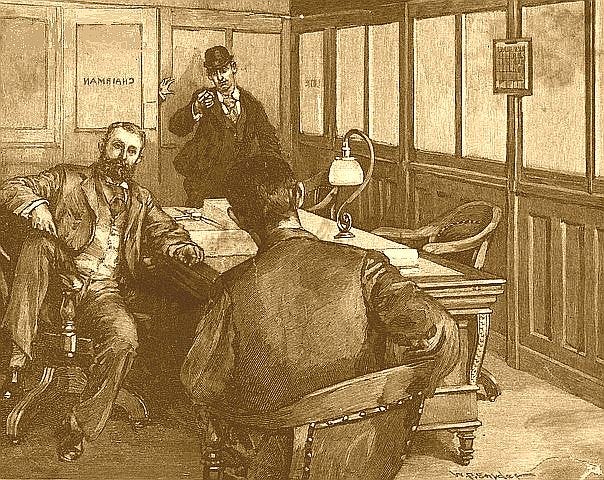
Though this type of act was primarily the domain of anarchists, socialists and communists could and did carry out dramatic acts for a variety of reasons and with varying degrees of success. Young Josef Stalin was famously involved in a bank robbery in 1907, the Erivansky Square Expropriation as it is romantically called, which was not terribly successful as a financial venture but made the Bolsheviks incredibly popular.
Once again closer to home, Leon Czolgosz, president McKinley’s assassin, was intentional about following propaganda of the deed as a doctrine. In his confession he wrote:
When I shot him I intended to kill him and the reason for my intention in killing was because I did not believe in presidents over us. I was willing to sacrifice myself & the president for the benefit of the country. I felt I had more courage than the average man in killing president and was willing to put my own life at stake in order to do it.
The trope of the “bomb-throwing anarchist” originates from this era, but even though the idea was at times supported by certain prominent anarchists like Mikhail Bakunin and Peter Kropotkin, propaganda of the deed was always a minority position, even among radicals. The results were mixed, at best, and it eventually fell out of favor as organized labor and communist revolutions racked up more wins.
One of the other terms for this kind of behavior is the aforementioned ‘adventurism’.
Let’s Go on an Adventurism
Some talking heads and pundits have misinterpreted Piker’s remarks as portraying political violence or criminal misbehavior as like going on an adventure. This is because they are very dumb or because they are paid to say these things, as it would be impossible to understand his remarks this way even if you don’t know the history of adventurism. Here’s what he said in a later conversation:
In the Marxist tradition, adventurism is the action that is oftentimes decentralized. Oftentimes, anarchists will say, “This is the propaganda of the deed.” The action itself, no matter how violent or how disruptive, is justifiable because the disruption is the point. I believe in the power of organized labor and labor militancy, and building these structures of power so that we can actually make more effective change, more longstanding change.
That’s the really funny thing about this to me. Because Piker had some positive things to say about Luigi Mangione and said that stealing from corporations isn’t a big deal, he has been accused of supporting that type of behavior, but Marxists explicitly disagree with adventurism as a political tactic! Lenin and Trotsky both wrote articles warning against it. It is important to understand that this critique is strategic and structural. Here’s what Lenin had to say:
When Marxists say that certain groups, are adventurist, they have in mind the very definite and specific social and historical features of a phenomenon, one that every class-conscious worker should be familiar with.
And Trotsky:
If opportunism is characterized by a passive adaption to objective conditions (“chvostism”). adventurism, which is the antipode of opportunism, is characterized by its wanton and disdainful attitude towards the objective factors.
The reason why socialists generally oppose adventurism isn’t because they think it’s wrong (though they might), it’s because they think it’s ineffective and counterproductive. If you are focused on organizing the working class and believe that power grows exclusively from coordinating class interests, then individual acts of violence or sabotage are either antithetical to your goals or at best, a distraction and waste of effort.
There’s an obvious reason why we’re talking about this now, and why Piker brought it up, and that’s because it is once again extremely relevant. We are once again living in an era of extreme adventurism. Assassinating a healthcare CEO, lighting a warehouse on fire, throwing firebombs at Sam Altman’s house, these are all textbook examples of adventurism. Political violence is on the rise as well, or the high-profile kind is at least, and the people carrying out these attacks have motivations not unlike Czolgosz and Narodnaya Volya.
What’s notable and unique in this era, however, is that the adventurism is largely taking place among the right and center. Mangione and Altman’s attackers are hardly socialists, let alone anarchists. There have been several attempts on Trump’s life, all by people holding explicitly right-wing or center-left beliefs (Cole Thomas Allen, the most recent one, even posted critically of Piker on BlueSky).
I wrote previously about the Years of Lead, and I still think we are living through something like that, but this is not a desirable state of affairs if you actually want to fix a country or see its people thrive, and socialists have, even when revolutionary, historically been opposed to individual acts of violence.
If history is any guide, however, we are likely to see more adventurism, not less, as conditions get worse and the contradictions heighten.
Sorry!
Further Reading and Works Cited:
https://www.marxists.org/archive/lenin/works/1914/jun/09.htm
https://theanarchistlibrary.org/library/leon-czolgosz-confession-to-the-assassination-of-president-william-mckinley
https://www.marxists.org/archive/trotsky/1931/xx/success-danger3.htm
https://theanarchistlibrary.org/library/constance-bantman-the-era-of-propaganda-by-the-deed